Platform Capabilities
Everything needed to build a full-stack business platform
Not a template tool. Not a no-code toy. A production-grade AI system that generates real code,
real backends, and real deployments.
New
🎨
Studio: AI-First Platform Builder
A visual workspace where you design your platform with AI assistance. Studio coordinates Vitto's generation
pipeline
with a real-time editing canvas, see your platform take shape visually as AI writes the code behind every
component.
Visual design · AI generation · Real-time preview
New
🧠
Metacognition: Conscience & Introspection
Vitto has an inner monologue you can actually watch. The Conscience stream shows you Vitto's real-time
reasoning
as he works. Introspection gives admins a god-view of all AI activity across the entire platform.
Live reasoning stream · Per-user conscience · Admin overview
New
💬
Rich Messaging: Interactive Everywhere
Vitto sends interactive card messages with action buttons, status chips, and quick-reply suggestions.
The same rich experience works across WhatsApp, Slack, and the web, unified by a smart channel adapter
system.
5 message types · Channel adapters · Generative UI
Core AI
🏗️
Full-Stack Module Generation
Describe what you need in plain language. Vitto's generation pipeline creates production-ready components,
typed services, API endpoints, data models, and styles, a complete platform in under three minutes,
with 40+ files when a module needs depth.
Under 3 min · full platform · 40+ files · Production-ready code
Live
🖥️
Computer Use: Autonomous Browser Control
Vitto takes over the browser and acts like a human operator. 23 steps, Gmail sent in 3 minutes.
Secure isolated environments on dedicated hardware for maximum speed and privacy, 52% faster on repeat
tasks.
Secure sandboxes · Live streaming · Persistent sessions
AI Router
⚡
Smart Multi-Model Routing
Vitto's centralized model router picks a model per task, complexity, budget, and guardrails, with
enforcement in the platform instead of ad-hoc in every chat.
Claude 4.6 · GPT-4.1 · Gemini 3 · DeepSeek · Budget guard
Live
📡
Proactive Health Monitoring
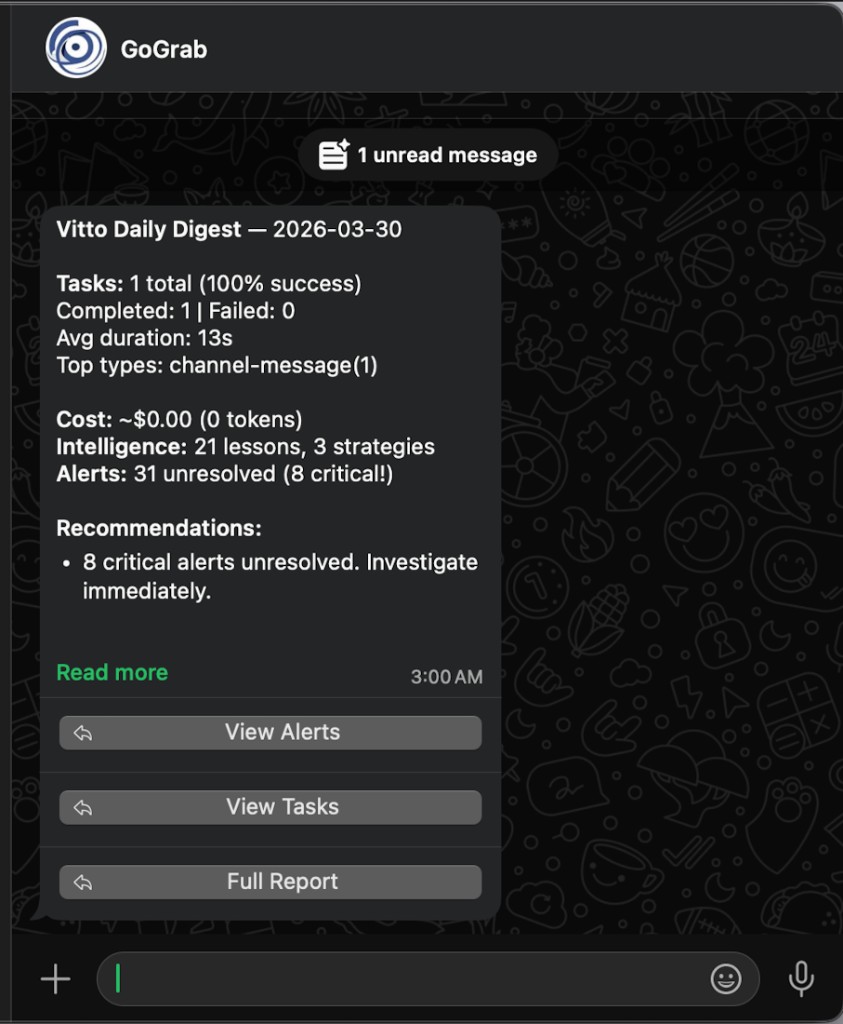
Vitto's ProactiveDispatcher watches API health, build pipelines, and deployment status with 5 safety guards.
Quality drops trigger instant WhatsApp alerts with one-tap approval. Critical alerts bypass quiet hours.
Hourly quality checks · Severity routing · 5 safety guards
Live
💻
Vitto Desktop App
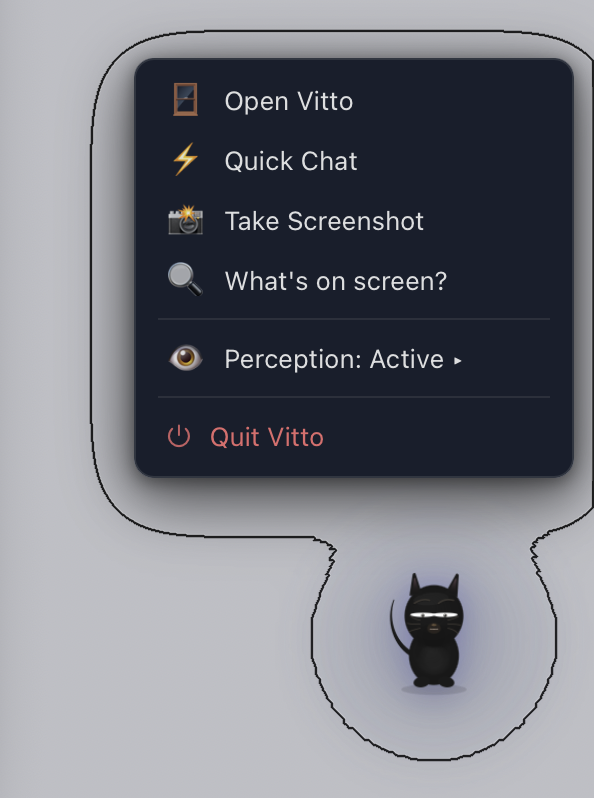
Native desktop app (Tauri v2). Press ⌘⇧V
anywhere to summon Vitto.
System tray integration, OS notifications, auto-start. Vitto lives on your machine, not just in a tab.
Tauri v2 · macOS / Windows / Linux
MCP
🔧
90+ Tool MCP Intelligence Server
The GoGrab intelligence server connects to any AI assistant (Claude Desktop, Cursor, or the web app) and
gives them 90+ tools across 14 categories: generation, coordination, automation, monitoring, and more.
90+ tools · 14 categories · Works everywhere
Intelligence
📋
User Dossier & Dialectic Learning
Vitto builds a rich personal profile through natural conversation, preferences, communication style,
skill level, goals. He uses "dialectic enrichment" to naturally ask what he doesn't yet know about you.
Auto-enrichment · 15-min sync · Bidirectional learning
Multi-Agent
🤖
10-Agent Space Builder
Vitto coordinates 10 specialist agents simultaneously, Page Designer, Widget Creator, Style Expert, UX
Optimizer,
SEO Advisor, Performance Guru and more, each contributing their domain to your platform in parallel.
Parallel execution · Agent lifecycle management
Platform
🎨
AI Theme Engine
Describe your brand in words. Vitto generates a complete design system with 12 theme archetypes,
full dark mode, CSS custom properties throughout, and WCAG AAA accessibility built-in.
12 archetypes · Dark mode · WCAG AAA
v7
🧩
VS Code extension: code where you live
Work on the generated platform directly inside Visual Studio Code. The Vitto extension brings chat, context,
and the same live Vitto beside your tree, refactors and reviews stay next to the files Vitto touched.
IDE-native · Same tasks as web · Tight repo loop
Live
📶
Omnichannel continuity
Start a task in the browser, get pinged when your task ships, nudge Vitto from Slack, and finish on desktop
, one
orchestrated brain, not six disconnected bots. Follow-ups and proactive nudges are first-class, not an
afterthought.
Hand-offs · Notifications · Cross-device state
New
🧠
Smart Reasoning Depth
Fast answers for simple questions. Deep analysis when the stakes are high. Vitto automatically picks the
right reasoning
depth for every task, so you never overpay for a quick lookup or underinvest in an architecture decision.
Auto-routing · Cost-aware · Learns over time
New
📚
Specialist Agents That Learn
Vitto doesn't do everything alone. He selects from a roster of specialist agents, each tuned for a
different kind of work, and learns which one performs best for your tasks. The more you use it, the sharper
the selection gets.
Auto-selection · Quality tracking · Continuous learning
New
👁️
Visual Verification
When Vitto controls a browser or reads a screenshot, he doesn't act blindly. Every visual input is validated
first, filtering noise, checking integrity, and ensuring only meaningful data drives decisions. No garbage
in, no
garbage out.
Pre-action validation · Noise filtering · Reliable automation
New
🔗
Cross-Channel Memory
One conversation that follows you everywhere. Start on WhatsApp, continue on Desktop, finish in VS Code;
full context preserved. No re-briefing, no lost threads. Vitto remembers every interaction across every
channel.
8 channels · Unified thread · Zero context loss
Live
✓✓
Real Presence on WhatsApp
Vitto shows "typing..." indicators and blue ticks on WhatsApp, the same presence signals you expect from a
human.
It feels like chatting with a real team member, not pinging a bot.
Typing indicators · Read receipts · Human-like presence
New
🎙️
Voice Intelligence
Talk to Vitto naturally, by voice. He doesn't just hear words; he reads between the lines: urgency, stress,
cognitive load. Say "Hey Vitto" from any device. Your tone shapes how he responds, fast and decisive when
you're rushed, thoughtful when you're exploring.
Wake word · Tone-aware · Works on every device
New
💭
Thought Trace: Watch the Reasoning
Not just answers, the entire chain of thought. Thought Trace shows you exactly how Vitto arrived at a
decision:
what he recalled, what he weighed, why he chose path A over path B. Full transparency, in real time.
Live trace · Step-by-step · Fully transparent
New
🕸️
Personal Knowledge Graph
Vitto builds a living map of everything he knows about you and your project, preferences, decisions,
patterns, relationships.
It grows with every interaction and makes Vitto sharper the longer you work together.
Visual graph · Grows over time · User-correctable
Platform
🧩
40+ Platform Elements: Instant Deploy
Your generated platform ships as lightweight, self-contained components, over 40 ready-to-use elements with
built-in theming,
data binding, and action pipelines. One click to deploy live on the edge. No build step. No devops.
40+ elements · Edge deploy · Live preview in Studio
Trust
🔐
Enterprise-Grade Security
Encrypted vault for secrets. Full audit trail. Prompt injection guard. Credential redaction.
Per-channel rate limits. Circuit breakers. Retention policies. The kind of security posture serious
companies actually need.
Vault · Audit trail · Injection guard · Compliance-ready
Live
📊
Observatory: AI Cost & Health Dashboard
See exactly what your AI is doing and what it costs. Token spend by model, cost per user, agent performance,
sandbox stats, all in one dashboard. No mystery bills. No "we'll send a report later." Real-time
observability.
Real-time spend · Per-model breakdown · Health metrics
Intelligence
🪞
Identity Synthesis
Vitto builds a persistent self-model: your expertise, your patterns, your preferences, your avoidances.
It refreshes automatically and you can correct it anytime. The result? An AI that actually knows how you
work, not just what you asked five minutes ago.
Auto-updated · Correctable · Persistent memory